English
What is Cervical Disc Herniation?
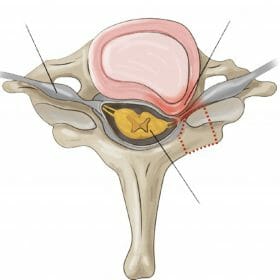
Cervical disc herniation occurs when the nucleus pulposus (inner gel material) of a cervical disc protrudes through a tear in the annulus fibrosus and compresses the spinal cord or exiting nerve roots. The cervical spine is the most mobile section of the spine, and the discs at C5-C6 and C6-C7 are most frequently affected due to the concentration of flexion-extension forces at these levels.
Types of Cervical Disc Herniation
- Soft disc herniation: Acute or subacute protrusion of disc material. More common in younger patients (<50). Often responds well to conservative treatment.
- Hard disc / osteophyte: Calcified disc material or bone spur. More common in older patients. Less likely to resolve spontaneously — surgical decompression often required for persistent symptoms.
- Radiculopathy: Nerve root compression causing arm pain, numbness, and weakness in a specific dermatomal and myotomal pattern.
- Myelopathy: Spinal cord compression causing progressive hand dysfunction, gait disturbance, and potential paralysis. Requires urgent surgical evaluation.
- OPLL (Ossification of the Posterior Longitudinal Ligament): Calcification of the spinal ligament causing cervical myelopathy — more common in East Asian populations. Requires careful surgical planning.
Symptoms by Cervical Level
- C4-C5 (C5 nerve root): Pain and weakness in the shoulder and deltoid. Shoulder abduction weakness. Biceps reflex may be reduced. No significant hand numbness.
- C5-C6 (C6 nerve root — most common): Pain radiating from the neck to the thumb and index finger. Biceps and wrist extensor weakness. Reduced biceps and brachioradialis reflexes.
- C6-C7 (C7 nerve root — second most common): Pain radiating to the middle finger. Triceps and wrist flexor weakness. Reduced triceps reflex.
- C7-T1 (C8 nerve root): Pain and numbness in the ring and little finger. Intrinsic hand muscle weakness — grip strength reduced. Reduced finger flexor reflexes.
Myelopathy Warning Signs — Seek Urgent Evaluation
- Clumsy or weak hands — difficulty with buttons, writing, or fine motor tasks
- Wide-based or unsteady gait — feeling of walking on uneven ground
- Heaviness or weakness in both legs
- Hyperreflexia — brisk or exaggerated reflexes in legs or arms
- Hoffmann sign — finger flexion when middle finger nail is flicked
- Bladder urgency or frequency without urological cause
- Electric shock sensation down the spine with neck flexion (Lhermitte sign)
These signs indicate spinal cord compression (myelopathy). Surgery prevents further deterioration and may partially restore function. Delay risks permanent neurological damage.
Diagnosis
- MRI (gold standard): Shows disc herniation, cord signal change (myelomalacia indicates chronic compression), and nerve root compression. Essential for all cervical spine surgeries.
- CT scan: Better defines calcified discs (hard disc, OPLL) and bony anatomy. Essential for surgical planning when calcification is present.
- Flexion-extension X-rays: Assess cervical instability — dynamic subluxation changes surgical planning from decompression alone to decompression plus fusion.
- EMG / Nerve Conduction Studies: Confirm radiculopathy and exclude peripheral nerve entrapment (carpal tunnel, cubital tunnel) mimicking cervical symptoms.
- SSEP / MEP (intraoperative monitoring): Used during surgery to monitor spinal cord function in real time — critical safety tool for all cervical cord procedures.
Conservative Treatment
- Physiotherapy: Cervical traction, soft tissue work, and scapular stabilisation. Manual therapy cautiously applied in radiculopathy; avoided in myelopathy.
- Cervical collar: Short-term use (2-4 weeks) for acute radiculopathy reduces motion and pain. Long-term use causes muscle deconditioning and not recommended.
- Medications: NSAIDs for pain and inflammation. Gabapentin or pregabalin for neuropathic arm pain. Oral steroids for acute severe radiculopathy.
- Cervical epidural steroid injection: Transforaminal or interlaminar injection reduces nerve root inflammation — 60-70% respond to 1-3 injections. Effective temporising measure while awaiting natural disc reabsorption.
- Surgery indication: Progressive neurological deficit, myelopathy, radiculopathy unresponsive to 6-12 weeks conservative treatment, or disabling pain.
Surgical Treatment at Bangkok International Hospital
ACDF — Anterior Cervical Discectomy and Fusion (Most Common)
The gold standard surgical treatment for cervical disc herniation with radiculopathy or myelopathy. A 3-4 cm transverse incision on the front of the neck provides access to the disc space. The herniated disc is removed along with any bone spurs under microscopic magnification. The disc space is filled with a titanium cage packed with bone graft. A small titanium plate and screws stabilise the segment during fusion. Single level: 1-1.5 hours. Hospital stay 1-2 nights. Collar 4-6 weeks. Office work 2-4 weeks. Full recovery 3-4 months.
Cervical Disc Arthroplasty (Artificial Disc Replacement)
An alternative to ACDF for single-level soft disc herniation in appropriately selected patients under 55 without significant facet arthritis. The artificial disc (Bryan Disc, Mobi-C, or ProDisc-C) replaces the herniated disc and preserves motion at the treated level — theoretically reducing the risk of adjacent segment disease compared to fusion. Not suitable for myelopathy, OPLL, significant facet arthritis, or multi-level disease. Hospital stay 1-2 nights. No collar required. Office work 1-2 weeks.
Posterior Cervical Endoscopic Foraminotomy
Minimally invasive posterior approach through a 10 mm endoscope. Bone and soft tissue removed to enlarge the nerve root tunnel (foramen) without entering the disc space. Preserves motion. Ideal for unilateral soft disc herniation or foraminal stenosis causing predominantly arm pain, particularly at C6-C7. Avoids the approach-related risks of ACDF (voice change, swallowing difficulty). Hospital stay 1 night. Office work 1-2 weeks.
Laminoplasty / Laminectomy for Cervical Myelopathy
Posterior procedures for multi-level cervical stenosis and myelopathy. Laminoplasty (open-door or French-door technique) expands the spinal canal by hinging the laminae open without removing bone — preserving posterior cervical stability. Laminectomy removes the laminae entirely — usually combined with fusion for stability. Both require intraoperative spinal cord monitoring.
Dr. Chaidej Sasomboon — Cervical Spine Specialist, Bangkok
- Fellowship: Minimally Invasive Spine Surgery, UCSF Medical Center (2019)
- Fellowship: Complex Spine Surgery, Columbia University Medical Center (2020)
- Residency: Ramathibodi Hospital, Mahidol University
- Member: NASS, RCST, Thai Medical Council
Recovery by Procedure
- ACDF: Hospital 1-2 nights — collar 4-6 weeks — office work 2-4 weeks — full recovery 3-4 months
- Disc arthroplasty: Hospital 1-2 nights — no collar — office work 1-2 weeks — full recovery 6-8 weeks
- Endoscopic foraminotomy: Hospital 1 night — no collar — office work 1-2 weeks — full recovery 4-6 weeks
- Laminoplasty: Hospital 3-5 nights — collar 4-6 weeks — office work 4-6 weeks — full recovery 3-6 months
Related Spine Conditions and Treatments
คำถามที่พบบ่อย — หมอนรองกระดูกคอทับเส้นประสาท
หมอนรองกระดูกคอทับเส้นประสาทคืออะไร?
หมอนรองกระดูกคอทับเส้นประสาท (Cervical Disc Herniation) คือภาวะที่หมอนรองกระดูกที่คอปลิ้นออกมากดทับรากเส้นประสาทหรือไขสันหลัง ทำให้เกิดอาการปวดคอร้าวลงแขน ชา หรืออ่อนแรง
อาการหมอนรองกระดูกคอทับเส้นประสาทเป็นอย่างไร?
อาการที่พบบ่อยได้แก่ ปวดคอร้าวลงไหล่และแขน ชาหรือเสียวที่แขน มือ หรือนิ้ว อ่อนแรงของกล้ามเนื้อแขน และในกรณีรุนแรงอาจมีขาอ่อนแรงหรือเดินไม่มั่นคง
วิธีการรักษาหมอนรองกระดูกคอมีอะไรบ้าง?
การรักษาเริ่มจากกายภาพบำบัดและยา หากไม่ดีขึ้นอาจพิจารณาการผ่าตัดแบบ Posterior Endoscopic Cervical Foraminotomy (PECF) ซึ่งเป็นวิธีแผลเล็กเพื่อคลายเส้นประสาทที่คอ หรือ ACDF สำหรับกรณีที่มีความไม่มั่นคง