English
What is Spondylolisthesis?
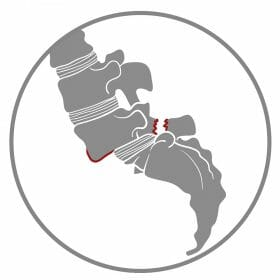
Spondylolisthesis is a condition where one vertebra slips forward over the vertebra below it. The term comes from Greek: spondylos (vertebra) and olisthesis (slipping). Even a few millimetres of slip can narrow the spinal canal and stretch or compress nerve roots, causing back pain and leg symptoms ranging from occasional aching to severe radiculopathy.
Meyerding Grading Scale
- Grade I (0-25% slip): Usually managed conservatively. Physiotherapy and activity modification effective in most cases.
- Grade II (26-50% slip): Surgical evaluation recommended if symptoms persist beyond 3-6 months of conservative care.
- Grade III (51-75% slip): Significant instability. Surgery typically recommended for symptomatic patients.
- Grade IV (76-100% slip): Severe instability. Surgical correction recommended to prevent neurological deterioration.
- Grade V / Spondyloptosis (>100%): Complete slip of the vertebral body. Complex reconstruction required.
Types of Spondylolisthesis
- Degenerative (most common in adults >50): Disc degeneration, facet joint arthritis, and ligamentum flavum laxity allow one vertebra to slide forward. L4-L5 most commonly affected.
- Isthmic: A defect or stress fracture in the pars interarticularis (spondylolysis) allows the vertebra to slip. Often presents in young athletes. L5-S1 most commonly affected.
- Congenital (dysplastic): Developmental abnormality of the sacrum or facet joints. Usually presents in adolescence.
- Traumatic: Acute fracture of the posterior arch from high-energy injury.
- Pathological: Bone destruction from tumour, infection, or metabolic bone disease undermines vertebral stability.
Symptoms
- Low back pain: Aching pain worsened by standing, walking, and extension. Improves with rest and flexion.
- Radiculopathy: Shooting pain, numbness, and weakness in the legs from compressed nerve roots — commonly the L4 or L5 nerve root.
- Neurogenic claudication: Bilateral leg heaviness that builds with walking — identical to spinal stenosis presentation. Sitting or leaning forward provides relief.
- Hamstring tightness: Classic in isthmic spondylolisthesis — muscles contract reflexively to prevent further slip.
- Cauda equina syndrome (rare emergency): Bilateral leg weakness, saddle anaesthesia, or bladder/bowel dysfunction requires immediate surgical evaluation.
Diagnosis
- Standing lateral X-ray: Essential first investigation. Quantifies the degree of slip. Must be taken weight-bearing — slip may not be visible on supine imaging.
- Flexion-extension X-rays: Reveal dynamic instability — a slip that worsens with movement confirms instability and strongly favours fusion over decompression alone.
- MRI: Shows disc degeneration, nerve root compression, and canal narrowing. Essential for surgical planning.
- CT scan: Better defines the pars defect in isthmic spondylolisthesis. CT myelogram if MRI is contraindicated.
- SPECT-CT: Identifies active bone stress reaction at the pars in isthmic cases — guides decision between conservative management and surgery.
Conservative Treatment
- Physiotherapy: Core stabilisation and flexion-based exercises reduce shear forces on the unstable segment. Usually 3-6 months before surgical evaluation.
- Bracing: Rigid lumbosacral orthosis for isthmic spondylolisthesis in children and adolescents — may allow pars healing if caught early.
- Epidural steroid injections: Reduce nerve root inflammation for radiculopathy and neurogenic claudication during conservative treatment period.
- Activity modification: Avoid high-impact loading (running, contact sports) and lumbar hyperextension (gymnastics, overhead lifting) during conservative treatment.
MIS-TLIF for Spondylolisthesis — Step by Step
MIS-TLIF (Minimally Invasive Transforaminal Lumbar Interbody Fusion) is the definitive surgical treatment for symptomatic spondylolisthesis. It achieves nerve decompression, partial slip reduction, and permanent stabilisation through two small incisions.
- Positioning and imaging: Patient prone under general anaesthesia. Intraoperative O-arm 3D scan registered to robotic system for navigation.
- Percutaneous screw placement: Four pedicle screws placed through 1 cm stab incisions under robotic guidance — no muscle stripping.
- Transforaminal access: 2-3 cm incision on the symptomatic side. Sequential tubular dilators open a working corridor through the muscle to the facet joint.
- Facetectomy and nerve decompression: Facet joint removed under microscope. Hypertrophied ligamentum flavum resected. Compressed nerve roots visualised and decompressed directly.
- Disc preparation: Disc space cleared and prepared. Endplates decorticated to allow bone fusion.
- Cage and bone graft: Titanium interbody cage packed with autograft bone and/or synthetic bone substitute placed into disc space. Restores disc height and indirect neural decompression.
- Rod connection and compression: Rods connected to pedicle screws. Controlled compression achieves slip reduction. Final O-arm confirms screw position and cage placement.
OLIF (Oblique Lateral Interbody Fusion) for Spondylolisthesis
OLIF is an alternative or complementary fusion technique to MIS-TLIF that accesses the lumbar disc space from an oblique lateral corridor — between the abdominal muscles and the psoas muscle — without entering the abdominal cavity and without any posterior muscle dissection. A 4-5 cm flank incision allows placement of a wide, tall interbody cage that restores disc height, corrects the slip indirectly through ligamentotaxis, and creates a large bony fusion surface.
For spondylolisthesis, OLIF is typically combined with posterior percutaneous pedicle screw fixation (OLIF + posterior fixation hybrid) to achieve both anterior column support and posterior stability. This combination is particularly effective for:
- Grade I-II degenerative spondylolisthesis with significant disc collapse and sagittal imbalance
- Multi-level disease requiring correction at more than one level
- Revision surgery after prior posterior procedures where posterior access is complicated by scar tissue
- Patients requiring significant disc height restoration and indirect foraminal decompression
Key advantages for spondylolisthesis: The large OLIF cage (width 18-22 mm, height 10-14 mm) provides superior endplate coverage and indirect foraminal opening compared to a posterior TLIF cage. No direct posterior muscle stripping means significantly less post-operative back pain. Hospital stay 3-5 nights. Return to light activity 4-6 weeks. Full recovery 3-4 months.
Robotic Assisted O-arm Navigation Pedicle Screw Fixation
Dr. Chaidej integrates robotic guidance with intraoperative O-arm 3D imaging for all pedicle screw-based procedures including MIS-TLIF and OLIF with posterior fixation. After the O-arm 3D scan is registered to the robotic system, the robotic arm positions the drill guide to within 1 mm of the pre-planned screw trajectory — achieving placement accuracy that is significantly superior to freehand or fluoroscopy-guided technique. This is particularly valuable in spondylolisthesis where forward slip distorts normal anatomical landmarks, making freehand screw placement challenging and increasing the risk of neurovascular injury. Real-time O-arm verification at the end of the procedure confirms final implant position before wound closure.
Dr. Chaidej Sasomboon — Spondylolisthesis Specialist, Bangkok
- Fellowship: Minimally Invasive Spine Surgery, UCSF Medical Center (2019)
- Fellowship: Complex Spine Surgery, Columbia University Medical Center (2020)
- Residency: Ramathibodi Hospital, Mahidol University
- Member: NASS, RCST, Thai Medical Council
Recovery After Minimally Invasive Lumbar Interbody Fusion
- Day 1-2: Walk with physiotherapist assistance. Oral pain medication. Drain removal.
- Day 3-5: Discharge home or to hotel. Leg pain typically dramatically reduced. Back soreness at incision sites.
- Week 2-4: Outpatient physiotherapy begins. Light daily activities. Office work possible week 3-4.
- Month 1-2: Walking distance increases steadily. Stationary cycling permitted.
- Month 3: CT scan confirms early fusion. Swimming and light gym work typically permitted.
- Month 4-6: Return to most physical activities. High-impact sports by 6 months if fusion confirmed.
Related Spine Conditions and Treatments
คำถามที่พบบ่อย — กระดูกสันหลังเคลื่อน (Spondylolisthesis)
กระดูกสันหลังเคลื่อนคืออะไร?
กระดูกสันหลังเคลื่อน (Spondylolisthesis) คือภาวะที่กระดูกสันหลังชิ้นหนึ่งเลื่อนออกจากตำแหน่งปกติ ทำให้กดทับเส้นประสาทและเกิดอาการปวดหลังร่วมกับปวดร้าวลงขา ชา หรืออ่อนแรง
กระดูกสันหลังเคลื่อนต้องผ่าตัดทุกรายไหม?
ไม่จำเป็นเสมอไป หากอาการไม่รุนแรงอาจรักษาด้วยกายภาพบำบัดและยา การผ่าตัดจะพิจารณาเมื่อมีอาการรุนแรง มีการกดทับเส้นประสาท หรือกระดูกเคลื่อนระดับ Grade 2 ขึ้นไปและไม่มั่นคง
MIS-TLIF และ OLIF คืออะไร?
MIS-TLIF และ OLIF คือเทคนิคการเชื่อมกระดูกสันหลังแบบแผลเล็ก โดยใส่ cage ระหว่างกระดูกสันหลังเพื่อเสริมความมั่นคง และยึดด้วย pedicle screw ผ่านแผลเล็กพร้อม O-arm navigation เพื่อความแม่นยำสูงสุด