English
What is Lumbar Disc Herniation?
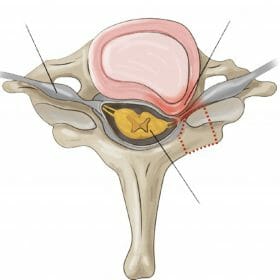
Lumbar disc herniation occurs when the nucleus pulposus pushes through a tear in the annulus fibrosus, pressing against spinal nerve roots and causing pain, numbness, and weakness radiating from the lower back down the leg — known as sciatica. The L4-L5 and L5-S1 discs account for over 95% of all lumbar herniations.
Types of Lumbar Disc Herniation
- Disc Bulge: Outer annulus intact but stretching outward. Often asymptomatic.
- Protrusion: Nucleus pushes against annulus without breaking through.
- Extrusion: Nucleus breaks through annulus — causes severe nerve compression.
- Sequestration: Free fragment migrates in spinal canal. Risk of cauda equina syndrome.
Nerve Root Symptoms by Level
L4-L5 (L5 root): Pain to outer leg and top of foot, great toe weakness, heel walking difficulty. Most common level.
L5-S1 (S1 root): Pain down back of leg to heel, plantar flexion weakness, reduced ankle reflex.
L3-L4 (L4 root): Anterior thigh pain, quadriceps weakness, reduced knee reflex.
Cauda Equina Syndrome — Surgical Emergency: Central herniation causing bilateral leg weakness, saddle anesthesia, and bladder/bowel loss requires emergency decompression within hours.
Diagnosis
- MRI (gold standard): Shows disc morphology, nerve compression, and canal involvement without radiation.
- CT scan: For calcified fragments and bony anatomy when MRI is contraindicated.
- Straight leg raise test: Reproduces radicular pain at 30-70 degrees elevation — positive in 80% of confirmed herniations.
- EMG / Nerve conduction study: Objectively documents nerve damage when imaging and clinical findings disagree.
Conservative Treatment
80-90% of lumbar disc herniations improve within 6-12 weeks without surgery:
- Physiotherapy: Core stabilisation, McKenzie method, neural mobilisation — reduces nerve tension and strengthens supporting muscles.
- NSAIDs and muscle relaxants: Manage acute inflammation and pain.
- Transforaminal epidural steroid injection (TFESI): Targeted steroid delivery to the inflamed nerve root provides weeks-to-months relief.
- Activity modification: Avoid prolonged sitting, heavy lifting, and forward bending during acute phase.
Surgery is indicated when conservative treatment fails after 6-12 weeks, neurological deficits are progressive, or cauda equina syndrome is present.
Surgical Treatment at Bangkok International Hospital
Full-Endoscopic Discectomy
The most minimally invasive option. An 8 mm working channel endoscope is inserted through a tiny skin incision. Under high-definition direct visualisation, the herniated fragment is removed while the nerve root is protected. Procedure time 45-90 minutes. Same-day or overnight admission. Return to desk work in 1-2 weeks, full activity in 4-6 weeks.
Microscopic Discectomy (Microdiscectomy)
Gold-standard approach through a 2-3 cm incision with microscopic magnification. Excellent for complex and recurrent cases. Hospital stay 1-2 nights. Office work in 2-4 weeks.
MIS-TLIF (with Instability)
When herniation accompanies significant spinal instability, MIS-TLIF fuses adjacent vertebrae through small incisions using a titanium cage and percutaneous pedicle screws — decompressing the nerve and restoring stability simultaneously.
OLIF (Oblique Lateral Interbody Fusion)
OLIF is a minimally invasive fusion technique that approaches the lumbar spine from an oblique corridor between the abdominal muscles and the psoas muscle — without entering the abdominal cavity and without retracting the psoas. A 4-5 cm flank incision provides direct access to the disc space from the side, allowing placement of a wide, tall interbody cage that restores disc height, indirectly decompresses nerves through ligamentotaxis, and corrects sagittal alignment.
Key advantages over posterior fusion approaches:
- No posterior muscle dissection — significantly less back pain post-operatively
- Large cage footprint covers more endplate area — higher fusion rate and better load distribution
- Excellent indirect decompression — cage height restoration opens the foramen and central canal without direct laminectomy in many cases
- Ideal for multi-level degenerative disc disease and lumbar flat-back deformity correction
- Can be combined with minimally invasive posterior percutaneous screws (lateral + posterior hybrid approach)
Indications: Degenerative disc disease with instability, grade I-II spondylolisthesis (combined with posterior screws), lumbar spinal stenosis requiring indirect decompression, adjacent segment disease after prior fusion, and multi-level degenerative flat-back deformity correction.
Hospital stay: 3-5 nights. Return to light activity 4-6 weeks. Full recovery 3-4 months.
Dr. Chaidej Sasomboon — Spine Surgeon, Bangkok International Hospital
- Fellowship: Minimally Invasive Spine Surgery, UCSF Medical Center, San Francisco (2019)
- Fellowship: Complex Spine Surgery, Columbia University Medical Center, New York (2020)
- Residency: Orthopaedic Surgery, Ramathibodi Hospital, Mahidol University
- Member: North American Spine Society (NASS), Royal College of Surgeons of Thailand (RCST), Thai Medical Council
Dr. Chaidej performs full-endoscopic discectomy using the latest endoscopic platforms. His minimally invasive philosophy means smaller wounds, less post-operative pain, and faster return to normal life.
Recovery Timeline
- Endoscopic discectomy: Walk same day — discharge 1 night — office work 1-2 weeks — full activity 4-6 weeks
- Microdiscectomy: Walk next day — discharge 2-3 nights — office work 2-4 weeks — full activity 6-8 weeks
- MIS-TLIF: Walk day 2-3 — discharge 3-5 nights — light activity 4-6 weeks — full recovery 3-4 months
International Patients
Bangkok International Hospital provides English-speaking coordinators, JCI-accredited facilities, insurance assistance, and pre-surgery telemedicine. Send your MRI for a remote consultation with Dr. Chaidej before travelling to Bangkok.
Related Spine Conditions and Treatments
คำถามที่พบบ่อย — หมอนรองกระดูกทับเส้นประสาทเอว
หมอนรองกระดูกทับเส้นประสาทเอวคืออะไร?
หมอนรองกระดูกทับเส้นประสาทเอว (Lumbar Disc Herniation) คือภาวะที่เนื้อเยื่อในหมอนรองกระดูกปลิ้นออกมากดทับรากเส้นประสาทกระดูกสันหลังส่วนเอว ทำให้เกิดอาการปวดร้าวลงขา ชา หรืออ่อนแรง
อาการหมอนรองกระดูกทับเส้นประสาทเอวเป็นอย่างไร?
อาการที่พบบ่อยได้แก่ ปวดหลังร้าวลงขาข้างใดข้างหนึ่ง ชาหรือเสียวที่ขา น่อง หรือเท้า อ่อนแรงของกล้ามเนื้อขา และปวดมากขึ้นเมื่อก้มหรือนั่งนาน
ต้องผ่าตัดหมอนรองกระดูกทุกรายไหม?
ไม่จำเป็น ผู้ป่วยส่วนใหญ่สามารถหายได้จากการรักษาแบบอนุรักษ์ เช่น กายภาพบำบัดและยา ภายใน 6–12 สัปดาห์ การผ่าตัดจะพิจารณาเมื่ออาการรุนแรง ไม่ดีขึ้น หรือมีอ่อนแรงของกล้ามเนื้อ
การผ่าตัดหมอนรองกระดูกแบบส่องกล้องใช้เวลาพักฟื้นนานแค่ไหน?
การผ่าตัดส่องกล้อง (Endoscopic Discectomy) เป็นการผ่าตัดแผลเล็ก ผู้ป่วยส่วนใหญ่สามารถเดินได้ภายในวันผ่าตัด และกลับบ้านได้ภายใน 1–2 วัน ฟื้นตัวโดยทั่วไปภายใน 2–4 สัปดาห์